
How many dumbbells does a gym need? A 300-600 member gym needs 15-20 pairs, running from 5 lb to 100 lb, with duplicates on the 15-35 lb sizes. A hotel or apartment fitness room gets away with 10 pairs from 5 to 50 lb. A large 24-hour site needs 22-30 pairs.
Member count alone does not get you there. What decides the number is how many people are holding dumbbells at the same time on a Tuesday at 6pm, and how those people spread across the weight range.
The five-step calculation
You can do this on a napkin. Work through it in order.
- Peak concurrent users. Take your member count and multiply by 8-12%. A 400-member gym peaks at 32-48 people in the building at once. Use 10% as the working figure, then check it against your door counter.
- Share in the free-weight area. Typically 30-45% of people in the building at peak. In a strength-heavy facility it runs higher. Call it 35%: 40 people becomes 14 in the free-weight zone.
- Share using dumbbells rather than barbells or machines. Roughly 50-65% of that group. Call it 60%: 14 people becomes 8 holding dumbbells.
- Multiply by the spread factor. Concurrent users does not equal pairs, because users need different weights. Between 2 and 2.5 times the concurrent count covers the spread. 8 × 2 = 16 pairs.
- Add duplicates on the hot sizes. Three or four extra pairs at 15-35 lb. Total: 19-20 pairs.
That is a mid-size commercial gym in one line of arithmetic. The spread factor is the part people miss. Twelve people can train at once with twelve pairs only if they all want different weights, which never happens at 6pm.
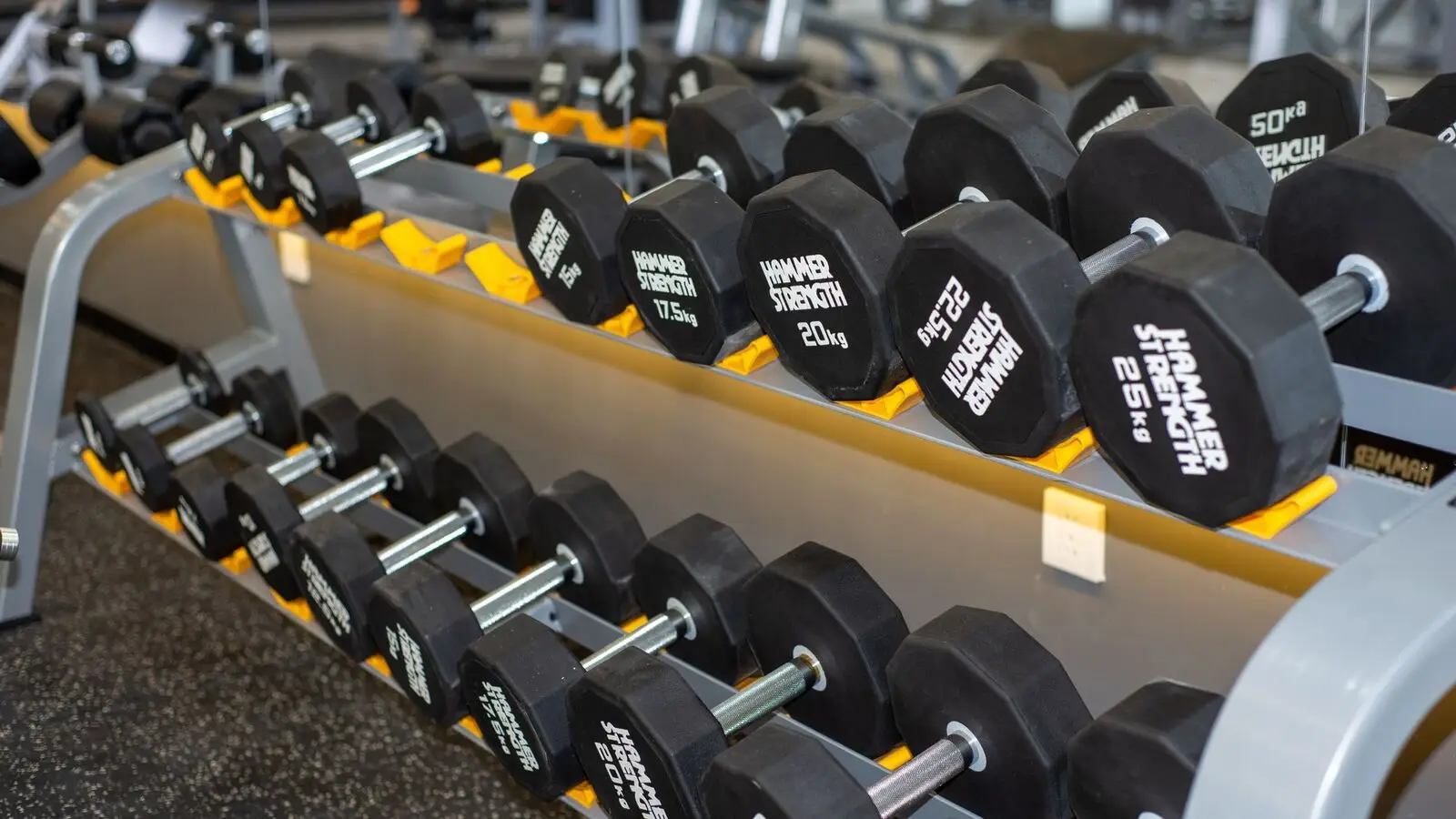
How many dumbbells does a gym need by facility type
| Facility | Users | Peak concurrent | Pairs | Weight range | Rack length |
|---|---|---|---|---|---|
| Hotel / apartment fitness room | 60-150 | 4-8 | 10 | 5-50 lb, 5 lb steps | One 2-tier rack, ~8 ft |
| Boutique studio / personal training | 150-300 | 8-12 | 12-14 | 5-60 lb | One 3-tier rack, 9-10 ft |
| Mid-size commercial gym | 300-600 | 25-60 | 15-20 | 5-100 lb | One 3-tier rack, 10-11 ft |
| Large 24-hour or big-box site | 800-2,000 | 80-200 | 22-30 | 5-120 lb, 4-6 duplicates | Two 3-tier racks, 20-22 ft |
| Strength / powerlifting facility | 150-400 | 15-30 | 8-12 | 5-75 lb | One 3-tier rack, 9-10 ft |
Two notes on reading that table. “Users” for a hotel or apartment room means residents and guests, not paying members, and the peak is short and shallow. For a strength facility the dumbbell count drops because barbells and plate-loaded machines carry the heavy work.
What 15 pairs actually weighs
The standard commercial build is 5-50 lb in 5 lb steps, then 55-100 lb in 10 lb steps. That is 10 pairs plus 5 pairs.
| Block | Pairs | Total weight | Metric |
|---|---|---|---|
| 5-50 lb, 5 lb steps | 10 | 550 lb | ~250 kg |
| 55-100 lb, 10 lb steps | 5 | 750 lb | ~340 kg |
| **Total, 15 pairs** | **15** | **1,300 lb** | **~590 kg** |
| Full 5-100 lb in 5 lb steps | 20 | 2,100 lb | ~950 kg |
This matters at the purchase order and again at the container. A 20-pair set is close to a tonne of steel and rubber, so the freight maths is different from a container full of machines. In a 40ft high cube, weight stops being the limit somewhere around 15-18 complete sets. Below that, the racks and cartons eat the space first. Where weight does bite early is LCL pricing and the road limit on the delivery truck.
Where the 10 lb steps belong
Above 50 lb, 5 lb jumps stop earning their space. A 55 lb pair and a 60 lb pair do the same job for almost every member, and the heavier pairs take rack length you do not have. Stepping by 10 lb from 55 up is normal for commercial floors and it saves two full rack slots.
The light end is the opposite problem. If the smallest jump on your rack is 5 lb, you are telling a deconditioned member, a rehab client, or a 60-year-old beginner that their next option is a 25% load increase. Facilities that serve those groups well stock 2.5 lb pairs at 5, 7.5, 10, 12.5 and 15 lb, or keep a small set of micro dumbbells near the stretching area.

Duplicates: the cheapest fix for a queue
Members do not distribute evenly across the rack. They cluster. If you watch a busy free-weight floor for an hour, the empty slots are almost always the same: 15, 20, 25, 30 and 35 lb.
Before you buy more sizes, buy more of those. Adding one duplicate pair at 20 lb costs a fraction of extending the range to 120 lb and it removes more waiting. A simple way to find your hot sizes: put a piece of tape on the rack and mark each time a slot is empty at peak. Two weeks of marks tells you exactly which pairs to double.
Above 100 lb, be honest about demand. In most commercial gyms, pairs over 100 lb are used by a small fraction of members, often under 2%. Two or three pairs (105, 110, 120 lb) plus a set of adjustable or plate-loaded options covers that group without spending rack space and freight on a full run to 150 lb.
Rack length arithmetic
The rack is where most layouts go wrong. People count dumbbells, order them, then discover the rack is 2 ft longer than the wall.
Plan roughly 14-16 in of rail length per pair on a horizontal tier. That is an approximate figure, and saddle width varies by manufacturer, but it is close enough for layout work.
| Rack type | Typical length | Pair capacity | Best for |
|---|---|---|---|
| 2-tier horizontal | 60-96 in | 8-10 pairs | 5-50 lb sets, small rooms |
| 3-tier horizontal | 110-130 in | 20-24 pairs | Full 5-100 lb commercial set |
| 3-tier angled shelves | 90-120 in | 15-18 pairs | Heavier pairs, easier loading |
| Vertical tower | 24-36 in footprint | 5-8 pairs | Tight home and hotel rooms |
Then add clearance. Members stand in front of the rack with a pair in each hand, so you need 36 in of clear floor in front plus room to walk behind someone who is loading. Two racks facing each other need about 6 ft between them to work. If you are still at the drawing stage, the floor layout guide covers the zone spacing in more detail.
What to check before you order
- Pairs, not singles. A dumbbell rack with odd singles is a rack nobody can use. Order in pairs even when you are topping up.
- Welded heads. Rubber hex heads that are pressed or glued on work loose. Welded and then coated is the build to ask for on anything above 50 lb.
- Handle diameter. 32-35 mm handles suit most hands. Thicker is not better for high-rep work.
- Saddle width and spacing. Saddles that are too narrow let dumbbells rock and chip. Check that the spacing matches your heaviest head size.
- Rack load rating. A 20-pair commercial set plus rack is over 1,300 lb of steel and rubber sitting on one footprint.
- Coating choice. Rubber hex is the default. Urethane costs more and lasts longer in high-drop settings. Our commercial dumbbells guide breaks down the cost per pound difference.
Mistakes we see on incoming orders
Buying the range instead of the count. A 5-100 lb set in 5 lb steps looks complete on paper. Twenty pairs, one of each, still leaves eight people fighting over the 25s at peak.
Skipping the mid duplicates to afford heavier pairs. The 110 lb and 120 lb pairs impress visitors. The 25 lb pair that three people are waiting for is what members actually notice.
Mismatched rack capacity. Twenty pairs ordered, rack rated for 16, and now dumbbells live on the floor around it. Order rack and dumbbells from the same place, or verify capacity first.
Forgetting the bench and floor space. Dumbbells need benches and clear floor. Six benches for a 20-pair rack is a reasonable starting ratio for a commercial floor. Racks and benches are usually bought together for that reason.
No plan for plate-loaded free weights. Dumbbells are half of a free-weight area. Barbells, plates and a platform are the other half, and plate tonnage follows its own math. If you are working out how much plate weight the floor needs, the calibrated plates vs bumper plates guide includes the tonnage formula.
FAQ
Is a 5-50 lb dumbbell set enough for a small gym? For a hotel fitness room, an apartment gym under 150 units, or a personal training studio, yes. Ten pairs covers most of what those users do. Add a 55 and 60 lb pair if you have strength-focused residents.
Should dumbbells go up in 5 lb or 2.5 lb increments? 5 lb through the main range, 10 lb above 50, and a handful of 2.5 lb jumps at the very light end if you serve older members, rehab clients or beginners. Full 2.5 lb runs are expensive and mostly unused.
How many pairs of 25 lb dumbbells does one gym need? For a 400-600 member gym, two or three. It is one of the most-used sizes on any floor, along with 15, 20 and 30 lb.
Do we need dumbbells over 100 lb? Only if you have a genuine strength population. Check usage before you spend the rack space. Most commercial facilities do fine topping out at 100 lb with two or three heavier pairs.
Can we mix brands on one rack? You can, and it looks bad. Head sizes and saddle fit differ, so mixed brands rattle, chip and sit unevenly. If you are topping up an existing set, match the head profile.
Sizing a free-weight area
If you send us your member count, peak-hour door count and floor dimensions, we will come back with a pair list and a rack layout. Our gym equipment accessories range covers dumbbell racks and storage, and the benches and racks line covers the benches that go with them. For facilities that want one frame doing several jobs, the multi-function series is worth a look before you commit floor space to single-purpose stations.
Contact the factory with your numbers. We build these sets daily and we will tell you when you are overbuying, which happens more often than you would think.