
A weight stack is the part of a selectorized machine that buyers never put in the spec sheet and members never think about — until a cable snaps mid-set or the pin goes missing for the fourth time this month.
Here is the short version. Stack weight is a marketing number. What your member actually lifts at the handle is stack weight minus friction, multiplied by the pulley ratio. On a 2:1 machine a 200 lb stack gives you about 100 lb per hand. Buy the machine by the second number, and specify the increment, the cable rating, and the guide rod size while you are at it.
The short answer
- Stack size is not resistance. 1:1 machines deliver roughly the stack weight at the handle. 2:1 machines deliver about half. Check the ratio before you compare two machines on price.
- The increment matters more than the total. A 200 lb stack with 10 lb plates gives 20 steps of adjustment. A 200 lb stack with 15 lb plates gives 13, and members notice the gaps on small muscle groups.
- Cables and pulley wheels are the wear items. Not the plates. Not the frame. Budget for a cable and pulley kit per machine, and make sure your factory publishes cable lengths.
- Typical commercial stacks: 200–250 lb on chest press, shoulder press, lat pulldown, and seated row; 150–250 lb on leg extension and leg curl; 100–150 lb on ab and rotary torso; 150–200 lb per side on cable stations.
What is actually inside a weight stack
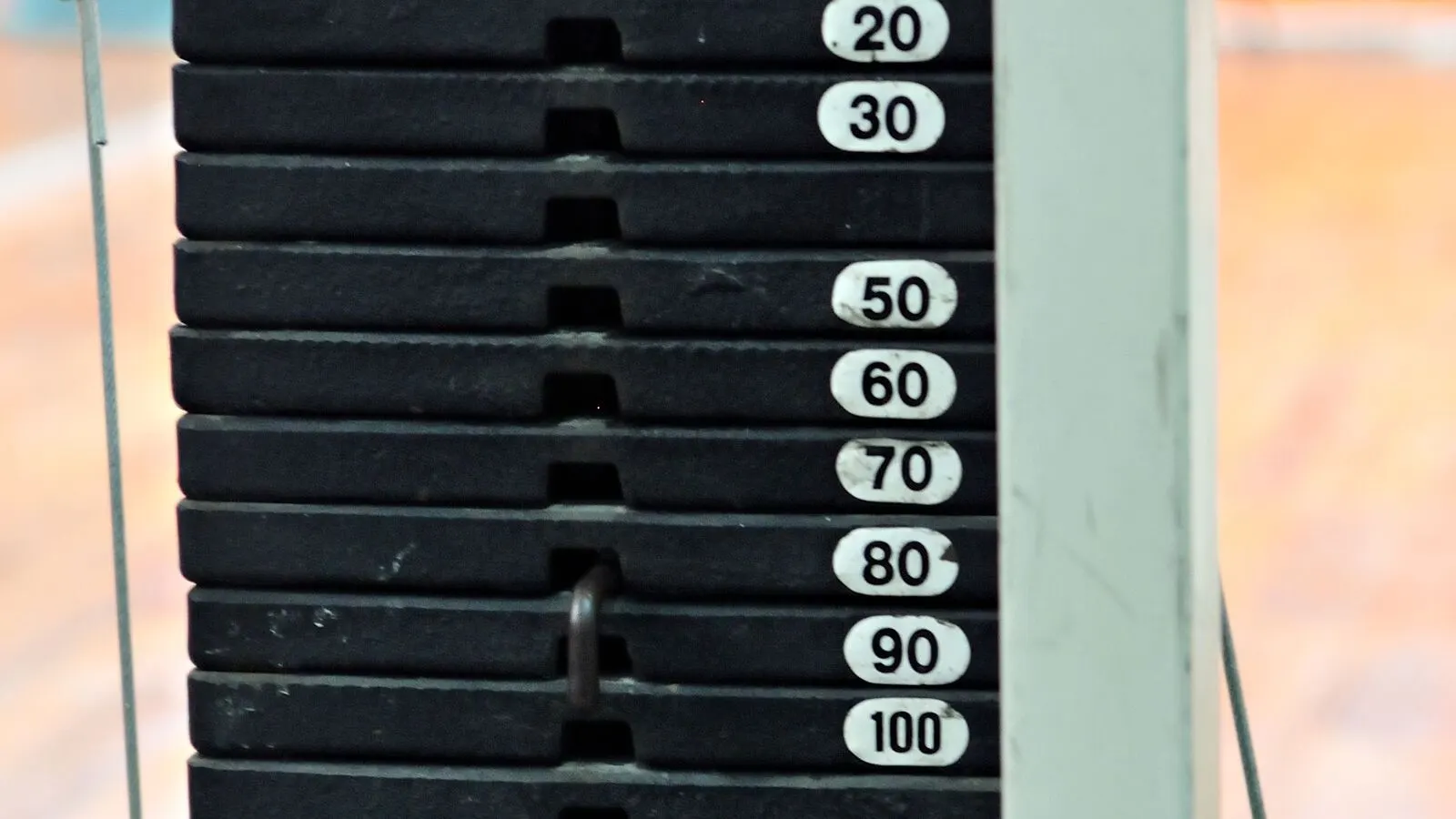
A stack looks like a solid block of steel in a shroud. It is a stack of individual plates threaded onto two guide rods, connected to the cable by a top plate, and held at the chosen weight by a selector pin.
The parts, in the order they fail:
- Cable. Galvanised steel, usually 5–6 mm, 7×19 strand construction. Breaking strength is typically 1,500–2,500 lb, and the working load is a small fraction of that. Cable failure is nearly always fatigue at the swaged end fitting or at a pulley bend, not a single overload.
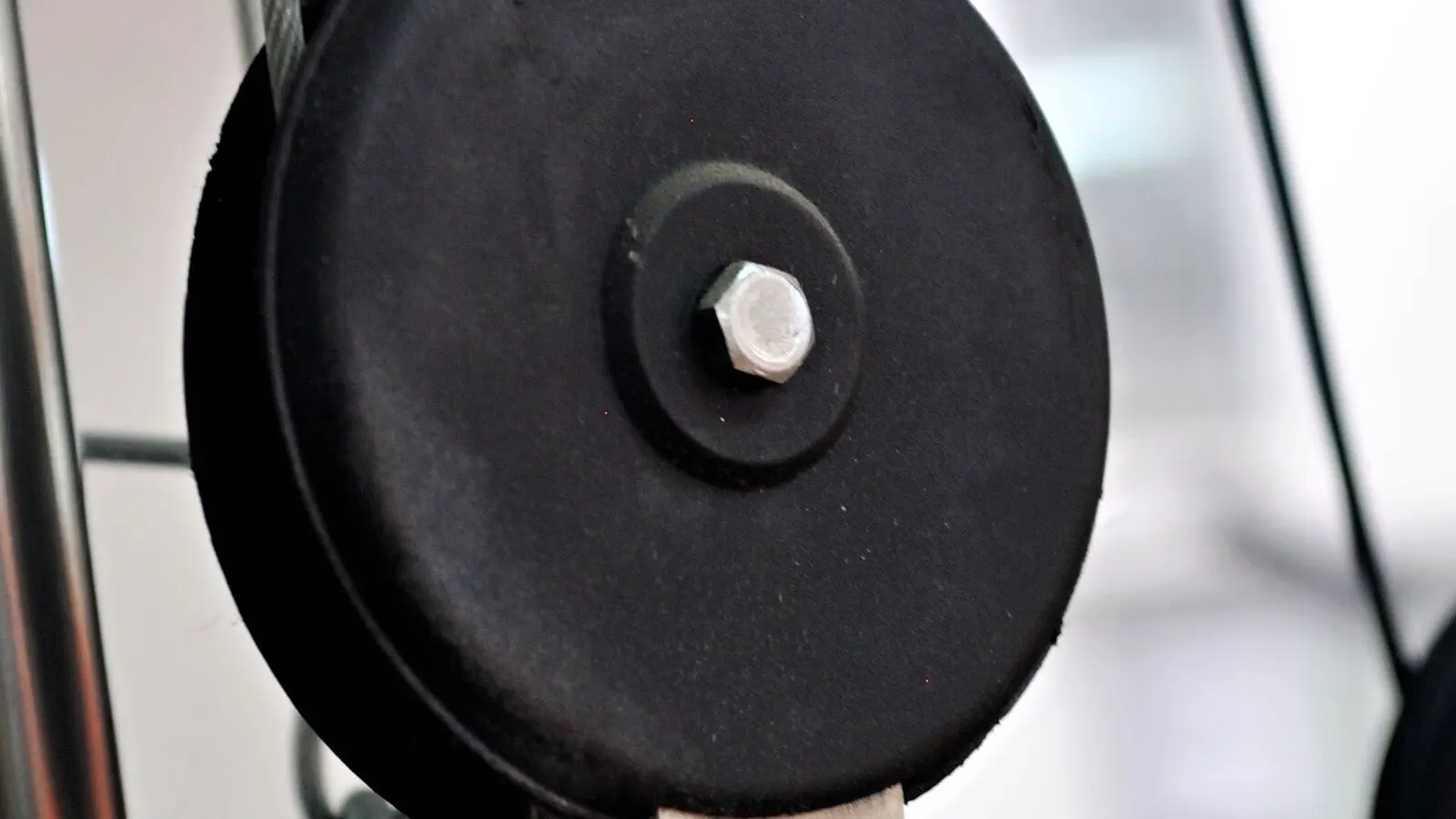
- Pulley wheels and bearings. Nylon or steel wheels with a bushing or a sealed bearing. A dry or flat-spotted wheel adds friction, which makes the machine feel heavy at the bottom and light at the top.
- Selector pin. Spring-loaded steel pin on a lanyard or a chain. The pin itself rarely breaks. The tether does, then the pin walks, then the machine is out of service for a week.
- Guide rods. Chrome-plated steel, 25 mm or 30 mm. Chrome thickness and adhesion decide whether they pit in a humid gym.
- Bushings or bearings inside the plates. Nylon bushings are the norm on mid-range machines. Linear ball bearings are smoother and less tolerant of chalk dust and hair.
- Plates. Cast iron or laser-cut steel, painted or powder coated, sometimes with urethane or rubber facing to cut noise.
Weight stack vs resistance: the pulley ratio question
This is the single most misunderstood number in the category.
A 1:1 machine moves the cable one inch for every inch the stack rises. The load at the handle is the stack weight minus friction, so a 200 lb stack gives you somewhere around 175–190 lb of actual resistance.
A 2:1 machine uses a moving pulley, so the cable travels twice as far as the stack rises. The load at the handle is roughly half the stack. A 200 lb stack gives about 100 lb.
| Ratio | Stack 200 lb gives | Typical machines | Trade-off |
|---|---|---|---|
| 1:1 | ~180 lb at handle | Lat pulldown, seated row, most selectorized presses | Full stack value, faster cable travel, less smooth |
| 2:1 | ~100 lb at handle | Functional trainers, cable crossovers, some lat pulldowns | Smoother and twice the cable travel, half the load |
| 3:1 / 4:1 | 50–65 lb at handle | Rehab and assisted-motion stations | Very light starting loads, long cable travel |
Two consequences for buyers. First, when a supplier quotes you a “200 lb stack” on a functional trainer, ask what the per-handle load is. Second, on a 2:1 machine, do not downsize the stack to save money: you are halving a number that was already modest.
Stack sizing by machine and member profile
Typical commercial ranges, based on what we build and what comes back as feedback:
| Machine | Typical stack | Typical increment | Notes |
|---|---|---|---|
| Chest press | 200–250 lb | 10 lb | 250 lb usually enough for all but strength-sport users |
| Shoulder press | 200–250 lb | 10 lb | Overhead strength runs lower than press strength |
| Lat pulldown | 200–250 lb | 10 lb | Heavy users pull the whole stack; 250 lb is the safer call |
| Seated row | 200–250 lb | 10 lb | Same reason, plus rowing tends to run heavy |
| Leg extension / leg curl | 150–250 lb | 10 lb | Quads take more than hamstrings; combo units often compromise |
| Ab crunch / rotary torso | 100–150 lb | 5–10 lb | Light increments matter here |
| Hip abduction / adduction | 150–200 lb | 10 lb | Higher stacks are rarely used |
| Assisted pull-up / dip | 100–200 lb assist | 10 lb | Assist stack, not resistance; bigger is friendlier |
| Cable station, 2:1 | 150–200 lb per side | 5–10 lb | 200 lb = ~100 lb per hand |
| Functional trainer, 2:1 | 150–200 lb per side | 5 lb | Add a 5 lb adder plate |
A 5 lb adder plate (the half-weight plate that hangs on top of the stack) costs almost nothing and solves most of the “the jump is too big” complaints on small muscle groups. Ask for it on lateral raise, rear delt, biceps, and abduction machines specifically.
Plate material: cast iron, steel, or faced
Cast iron plates are the default. They are cheap, heavy, and dimensionally fine for fitness use. Weight tolerance is typically ±2–3%, which nobody at the handle can feel.
Laser-cut steel plates are flatter and more consistent, and they can be cut to a tighter tolerance. They cost more. The benefit is not accuracy for its own sake. It is that a machine with well-cut plates slides quietly and does not develop the rattle that makes a gym sound cheap.
Faced plates, meaning urethane or rubber bonded to the plate, cut noise noticeably. In a hotel or apartment gym with a residential slab above or below, this is worth the upcharge. In a big commercial floor with music, it is a nice-to-have.
One thing to avoid: painted plates with no facing and a loose fit on the guide rods. That is the combination that produces the clanking noise members associate with worn-out equipment, even when the machine is new.
Guide rods, bushings, and cables, where cheap machines fail
Guide rods. 25 mm is standard, 30 mm is heavier and more stable under a stack that gets slammed. What matters more than diameter is chrome plating: thickness, adhesion, and whether the ends are sealed. In a humid climate or a gym with a pool next door, thin cosmetic chrome pits within a year and the stack starts dragging.
Bushings vs linear bearings. Nylon bushings are cheap, quiet when new, and tolerant of dirt. They develop play over time, which shows up as a stack that rocks as it rises. Linear ball bearings are smoother and tighter but hate chalk dust and hair, and they need the guide rods clean, which most gyms do not manage. For a 24-hour or unmanned facility, bushings are the lower-risk choice.
Cables. Ask for the construction (7×19 is typical), the diameter, and the end fitting type. Swaged fittings are standard. The important question is whether the cable runs over a pulley at a tight radius: a tight bend shortens cable life more than load does. Then ask whether the factory publishes cable lengths. If they do not, every future replacement becomes a measuring job.
The shroud and the pin: small parts, big complaints
A full shroud looks cleaner and stops members from chalking the stack or hanging towels on it. It also hides a failing cable until it snaps, so if you buy shrouded machines, put cable inspection on the maintenance schedule rather than relying on a glance.
The selector pin deserves more attention than it gets. Specify a captive pin with a steel lanyard, not a chain that snaps, and buy ten spares with the order. Pins go missing at a rate that surprises first-time buyers, and a machine without a pin is a dead station.
What to write on the purchase order
- Stack weight in lb and kg, plus the plate count that produces it
- Increment, and whether an adder plate is included
- Pulley ratio, and the effective load at the handle
- Cable diameter, construction, and published length
- Guide rod diameter, chrome spec, bushing or bearing type
- Shroud: full, half, or none
- Selector pin type, plus spare pins and lanyards
- Spare parts kit: one cable, two pulley wheels, one pin per machine type
That last line is the one most buyers skip. A container of selectorized machines without a matching cable and pulley kit means the first failure is a two-week wait, and in a 500-member gym a dead lat pulldown at peak is a member complaint you did not need.
Maintenance: the three-year list
| Interval | Check |
|---|---|
| Weekly | Cable for fraying at both end fittings, pin present and tethered, stack rises without noise |
| Monthly | Pulley wheels spin free, guide rods wiped clean, top plate bolt tight |
| Quarterly | Full cable inspection along its length, shroud removed, frame bolts re-torqued |
| Annually | Replace cables on high-use machines regardless of appearance, check chrome for pitting, replace worn bushings |
Cables are consumables. A lat pulldown in a busy gym runs thousands of cycles a month, and a cable that looks fine can fail at the swage with no warning. Replacing on a schedule is cheaper than replacing after an injury claim.
FAQ
What does a 200 lb weight stack actually mean? It means the plates total 200 lb. What the member feels at the handle is that figure minus friction, multiplied by the pulley ratio. On a 2:1 machine, expect roughly 100 lb per handle.
Why does the machine feel lighter than the number on the stack? Because of the pulley ratio. It is normal, not a defect. If two machines of the same type feel different, compare ratios and cable routing before assuming one is badly built.
Can I add weight to a stack? Yes, with a 5 lb adder plate on the top plate, or a magnetic add-on where the top plate is steel. Both are cheap. Neither is a substitute for buying the right stack size in the first place, because a stack that is too small for your membership cannot be fixed with a magnet.
What stack size should a commercial gym order? 250 lb on lat pulldown and seated row, 200–250 lb on presses, 200 lb per side on 2:1 cable stations. Small studios and hotel gyms can drop one step; a strength-focused facility should not.
How long do cables last? In a busy commercial gym, plan on two to four years for high-use machines and longer for the rest. That number moves with pulley radius, load, and how often the cable is inspected and lubricated at the fittings.
Cast iron or steel plates? Cast iron for value, laser-cut steel for quiet operation and tighter fit, faced plates where noise matters. All three are fine mechanically. The difference shows up in how the machine sounds after two years.
Specifying machines that hold up
If you are ordering selectorized machines for a new floor or replacing a tired circuit, send us the machine list and the membership profile, and we will come back with stack sizes, ratios, and a spare parts list that matches what you actually bought.
Start with the selectorized strength machine range or the cable crossover range if you are building a cable zone. For the wider buying decision, our guide to plate loaded vs selectorized machines covers which machines belong on a commercial floor at all, and the spare parts guide explains what to keep in stock.
Talk to our team with your floor plan and member count.