
Barbell storage is a 2.2 metre problem before it is a furniture decision. A standard men’s Olympic bar is 2.2 m long and weighs 20 kg, and it is the only piece of equipment in the building that is both that long and that heavy. Where it lives when nobody is using it decides whether your bars last fifteen years or five.
The short answer on layout: vertical floor holders win on floor space, horizontal wall racks win on bar condition, and most commercial facilities end up needing both. The rest of this guide is the arithmetic behind that, and the specification details that separate a rack that lasts from one that sags, wobbles, or puts the bar through the wall.
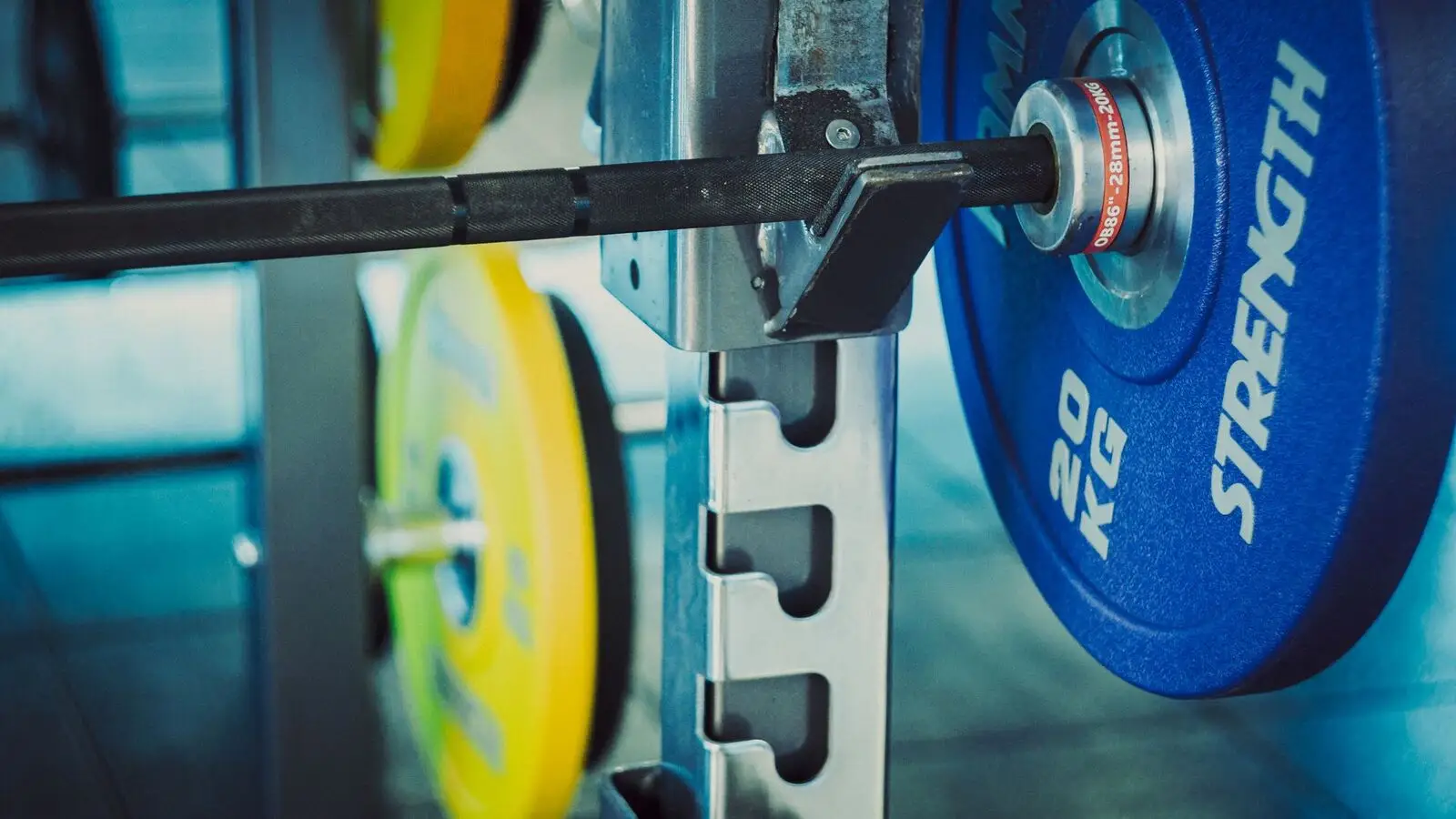
First, the length table
Storage decisions follow from bar length, not bar count. Get the lengths right and the layout mostly designs itself.
| Bar type | Typical length | Weight | Storage note |
|---|---|---|---|
| Men’s Olympic bar | 2.2 m (86.6 in) | 20 kg | The default; every calculation below uses this |
| Women’s Olympic bar | 2.01 m (79.1 in) | 15 kg | Fits the same racks, shorter overhang |
| Technique / junior bar | 1.5 m (59 in) | 5–10 kg | Often stored on the wall, not in a floor rack |
| EZ curl bar | 1.2 m (47 in) | 10 kg | Wall clips or a horizontal shelf |
| Trap / hex bar | 1.7–1.8 m (67–71 in) | 20–30 kg | Bulkier; needs a wider cradle, not a tube holder |
| Safety squat bar | 2.2 m (86.6 in) | 20–25 kg | Cambered; will not drop into a tight vertical cup |
| Log / axle bar | 1.2–2.2 m | 25–40 kg | Thick diameter; check cup internal diameter |
Two of those lines break standard storage. A safety squat bar with a camber will not seat in a narrow vertical cup, and a trap bar will not go in a tube holder at all. Specialty bars need cradles or a horizontal shelf, which is why the specialty bar count drives the storage mix more than the straight bar count does.
Five storage types, honestly compared
| Type | Capacity | Floor space | Wall space | Bar condition | Best for |
|---|---|---|---|---|---|
| Vertical floor rack | 5–9 bars | Very small, around 18 × 18 in for 9 | None | Sleeve coating wear at the contact point | Gyms with height and limited wall |
| Horizontal wall rack | 3–6 bars, stacked rows | Zero | 2.2 m of continuous wall per row | Best; bar supported near the sleeves | Facilities with wall and low ceilings |
| Horizontal floor rack | 4–10 bars, two or three tiers | 2.4 m × 0.6 m | None | Good | Where wall is unavailable but floor is |
| Combo rack | Mix of vertical posts and horizontal cradles | Medium | Optional | Good | One rack covering both straight and specialty bars |
| In-rack / on the machine | 1 per rack | None extra | None | Depends on the rack’s bar hooks | Working bars, not storage |
Wall-mounted single clips are worth a mention because they are cheap and widely bought, and also because a 20 kg bar hanging from two 5 mm steel hooks in drywall is a loaded question, not a storage solution.
Vertical versus horizontal: what actually happens to the bar
The trade-off is real and both camps are right about different things.
Vertical holders store a 2.2 m bar on its end, resting on the sleeve. Footprint is tiny, which is why a 9-bar holder at 18 × 18 in is the standard answer in CrossFit boxes and strength gyms with more bars than wall.
The costs:
- Sleeve coating wear. Metal on metal at the base cup grinds the sleeve coating off over years. Racks with plastic or UHMW inserts avoid it; bare steel cups do not. This is the most common complaint about vertical storage and it is entirely a design detail.
- Moisture and oil drain. Anything on the shaft runs down to one end. In a humid climate that end corrodes first.
- Ceiling clearance. You have to lift the bar above the top of the rack and drop it in. A 2.2 m bar in a 2.3 m holder needs a clear zone above it, which means a realistic minimum ceiling of about 2.5 m for comfortable handling. Basements and converted retail units at 2.4 m are where this bites.
- Swing. A 2.2 m bar being lowered into a cup is a long lever with a person on the end of it. Position vertical racks away from walkways and mirrors.
Horizontal racks support the bar at two points near the sleeves, which is where a bar wants to be supported. No coating wear, no moisture gradient, no overhead lift. The bar stays straighter over years, and in a facility where bars represent serious money that matters.
The cost is wall. A horizontal bar needs 2.2 m of continuous wall per row, the wall needs blocking or studs at the right centres, and the load pulls outward rather than downward, which is a different fixing problem to a floor rack.
There is a persistent claim that storing bars vertically bends them. It does not, in any normal installation, because the bar sits on its sleeve and gravity acts along its length. What does bend bars is leaning them against a wall at an angle, unsupported at the top, for months. That is a different mistake and a common one.
How many bars does your gym actually own?
Nobody counts bars until the storage runs out, and then they order a rack instead of counting. Do the count first.
The working method:
- One bar per power rack or squat stand. Non-negotiable. A rack without a bar is a $1,500 coat hook.
- Bench press stations. A bench inside a power rack shares the rack’s bar. A standalone bench press station needs its own, so count only the standalone ones.
- Platforms get 1.5 bars each. One working bar plus a shared spare, because lifters change bars between lifts and a platform with one bar creates a queue at the worst moment.
- Specialty bars. Count them individually. Safety squat bar, trap bar, Swiss bar, cambered bar, log: each is one slot, and most need a cradle rather than a cup.
- Fixed barbells are a separate inventory. Straight and EZ curl fixed bars live on a rack of their own; do not try to mix them into Olympic storage.
- Add 10 to 15 percent. Bars go out for re-knurling, come back from a competition, or get condemned after a bend. Empty slots are cheaper than a bar on the floor.
| Facility type | Racks / stations | Platforms | Bars to own | Storage units |
|---|---|---|---|---|
| Boutique strength studio | 3 racks, 1 bench station | 1 | 6–8 | One 9-bar vertical |
| 1,500 m² commercial club | 4 racks, 3 standalone benches | 2 | 12–16 | Two verticals, or one vertical plus a 6-bar wall rack |
| Powerlifting gym | 6 racks, 4 competition benches | 4 | 20–26 | Two verticals plus horizontal wall rows |
| CrossFit box | 12 rig stations | 0–2 | 15–20 | Two 9-bar verticals |
| School weight room | 8 stations | 0 | 10–14 | One vertical plus wall clips for technique bars |
A hybrid arrangement usually beats either extreme: keep two or three working bars on the racks where they are used, and store the rest centrally. Members then walk for the specialty bars and not for the common ones.
The two clearance numbers people get wrong
Ceiling. For a vertical rack, measure from the floor to the lowest obstruction, not to the ceiling. Sprinkler heads, ductwork, light fittings and ceiling fans all count, and a bar lifted into a sprinkler head is an expensive afternoon. Practical minimum is around 2.5 m of clear height for 2.2 m bars; below that, go horizontal.
Wall. For a horizontal wall rack, measure the continuous run you actually have, not the wall you wish you had. Mirrors, windows, columns, electrical panels and the gap behind a radiator all interrupt the run, and a 2.2 m bar does not fit into a 2 m space. A typical three-row, six-bar wall rack wants roughly 2.4 m of width and about 1 m of height, plus clearance to swing a bar in and out from the side.
Leave at least 900 mm (36 in) of clear floor in front of any storage, vertical or horizontal. Bars come out end-first and the person carrying one needs somewhere to stand.
Load and fixing: where cheap racks fail
A nine-bar vertical holder loaded with 20 kg bars is carrying 180 kg on a footprint of roughly 0.12 m². That is a point load of about 1,470 kg/m², or roughly 300 lb per square foot. On a ground-bearing slab that is nothing. On a mezzanine, a raised floor, or a timber-framed upper storey, it is worth a conversation with the structural engineer.
Wall racks have a different failure mode. The published capacity on a typical six-bar wall unit is around 300 lb (136 kg) combined, which comfortably covers six 20 kg bars at 120 kg — but only if the anchors are right. Six bars is 120 kg hanging 150 mm off the wall, and the pull-out force at the top anchor is higher than most people assume.
What to specify:
- Anchors into studs, blocking, or masonry. Not drywall plugs, not toggle bolts in 12 mm board.
- Blocking behind the wall if the wall is new. It costs almost nothing during fit-out and cannot be added later without opening the wall.
- Four anchors per upright minimum, with the load-bearing pair at the top.
- A base that reaches the floor on freestanding vertical racks, so the rack is not relying on wall fixings alone.
What to put on the purchase order
Most storage complaints trace back to a vague order. This list prevents almost all of them.
- Capacity in bars, and the bar diameter range it accepts (50 mm sleeves are standard, but check the cup internal diameter against thick axle bars)
- Overall height, width and depth, assembled
- Whether cups or cradles have plastic, UHMW or rubber contact surfaces
- Frame tube size and wall thickness; 2 × 2 in 11 gauge is the normal commercial floor, 2 × 3 in is better on nine-bar units
- Finish: powder coat over pre-treatment, and the colour reference
- Base feet: rubber pads or bare steel
- Fixing hardware included, and the anchor type
- Whether it ships knocked down, and what tools assembly needs
- Load rating as tested, not as estimated
Shipping bars and racks together
Bars are a shipping problem in the opposite direction to most gym equipment. They are heavy for their volume, which means they rarely fill a container but often eat its payload.
A crated 2.2 m bar needs a crate around 2.3 m long, which fits in a 20 ft container (internal length about 5.9 m) as well as a 40HQ. The crate cannot be double-stacked and cannot have anything heavy on top, so bars want to travel on the top layer of the load, strapped, with the void above them filled.
Racks ship knocked down in flat cartons, a handful per pallet, and are the cheapest part of the load per unit of value. A nine-bar vertical holder palletised is roughly 0.3 to 0.4 CBM.
Two practical notes for a mixed container:
- Put bars last, on top, with timber dunnage so the crate cannot slide.
- Order storage with the machines, not later. A standalone rack shipment is mostly freight.
FAQ
How many bars should a commercial gym keep in storage? Enough that every rack has a working bar and there are still spares. As a working rule, total bars equals racks plus 1.5 per platform plus specialty bars plus 10 to 15 percent. A 1,500 m² club with four racks, three standalone benches and two platforms lands around 12 to 16 bars.
Does storing a barbell vertically bend it? Not in a properly made holder, because the bar stands on its sleeve and the load runs along its length. Bars bend when they are leaned against a wall unsupported, or when a rack supports them in the middle rather than near the sleeves.
Why is the sleeve coating worn on my vertical rack? Bare steel cups. The bar rests metal on metal and every insertion grinds a little coating off. Racks with plastic, UHMW or rubber inserts do not do this. If the wear is already visible, replacement cups are usually available as a spare part.
Can I store a loaded bar in the rack? Strip it. Plates left on a stored bar put a permanent set into the shaft and, in a vertical holder, make the bar top-heavy and dangerous to insert.
Wall rack or floor rack for a low-ceiling basement gym? Wall rack, assuming you have 2.2 m of continuous wall and can fix into studs or block. If neither is available, a horizontal floor rack takes about 2.4 × 0.6 m of floor and needs no wall at all.
Do I need a separate rack for specialty bars? Usually yes for the trap bar and the safety squat bar, both of which will not seat in standard vertical cups. A combo rack with horizontal cradles covers the awkward shapes and keeps the straight bars vertical.
Specifying storage with the machines
Storage is the cheapest part of a gym order per unit of floor space, and the part most often left to the last week before opening. Order it with the racks, the platforms and the plates, in the same container, and specify the contact surfaces rather than just the bar count.
Start with the power racks and benches or the gym equipment accessories, and if you are building the whole free weight zone, the plate loaded range covers the machines that go around it. Send us your rack and platform count and we will work out the storage quantities and the container plan with you. Get a quote here.