
Specialty Barbell Buying Guide: Which Bars a Commercial Gym Should Stock First
A commercial gym needs two specialty barbells before it needs ten. Buy a safety squat bar and a trap bar first, add a Swiss bar once your straight bars are properly stocked, and leave the rest on the wish list until members ask for them by name.
That order matters more than brand. Specialty barbell shopping goes wrong when a buyer copies a powerlifting gym’s rack into a 6,000 sq ft fitness club, ends up with a log bar nobody can press and a cambered bar that doesn’t fit the j-cups, and still has no bar that a 58-year-old member with a bad shoulder can squat with.
This guide is written from the factory side of the order, where you see which bars come back as warranty claims and which ones stay bolted to the rack for a decade. Specs below are typical ranges, not catalogue promises; every factory bends steel slightly differently.
Why a bar beats a machine on cost per station
A selectorized machine occupies 20 to 30 sq ft and costs $900 to $2,500. A specialty bar costs $120 to $260 factory direct, hangs on a $40 wall hook, and opens up a movement pattern you could not otherwise offer.
What a bar gives you that a machine cannot:
- It keeps injured members training. A safety squat bar takes the load off a cranky shoulder. A trap bar takes it out of the lower back’s weakest position. Members who can keep training keep paying.
- It creates programming variety without new floor space. One rack plus four bars is four exercises. Four machines is 100 sq ft.
- It survives abuse. There is no cable to snap, no stack to jam, no console to break. A bar’s failure mode is cosmetic.
The trade-off is throughput. A bar serves one member at a time and needs a rack, so bars are a poor answer to peak-hour queues. Use them to widen what the floor can offer, not to increase capacity.
The two bars to buy first
Safety squat bar (SSB)
The SSB is a cambered bar with a yoke that sits on the traps and handles out front. The camber puts the load slightly forward and low, which forces an upright torso and spares the shoulders and wrists that a straight-bar back squat punishes.
What to check, in order of how often it goes wrong:
- Handle position and angle. Cheap SSBs weld the handles too far forward, which turns every squat into a front-loaded good morning. Ask for the handle centre distance and the angle from the shaft.
- Camber clearance. The bend has to clear the back of the neck without pressing into the spine. Handle-to-pad geometry varies by 2 to 3 cm between factories, and that is the difference between comfortable and unusable.
- Pad. Some SSBs ship with a bare steel yoke. Specify closed-cell foam wrapped in vinyl or PU, replaceable, at least 40 mm thick.
- Weight. Typical commercial SSBs run 25 to 32 kg. Heavier is not better here; you want the bar to balance, not to add load to a beginner’s first rep.
- Weld quality at the camber. This is the highest-stress joint on the bar. Look for a full-penetration weld with no undercut, and ask what bend test the factory runs.
The SSB is also the bar most likely to be used badly. Members rack it by dropping it onto the j-cups from height, which cracks welds over a couple of years. A pair of urethane j-cup inserts costs almost nothing and prevents most of it.
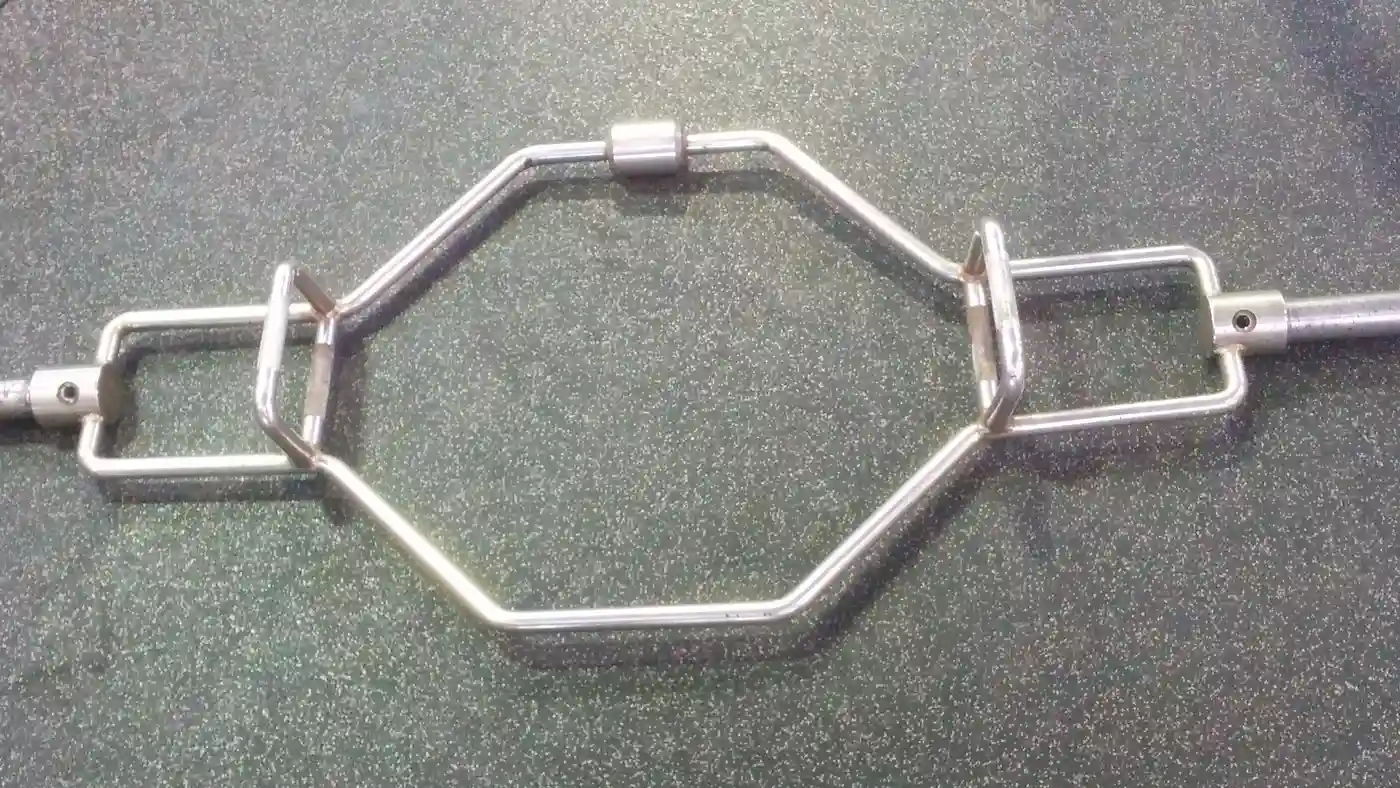
Trap bar (hex bar)
A trap bar puts the member inside the load. That changes the deadlift from a hip-hinge test into something closer to a squat with a neutral grip, which is why it is the single most useful bar for general population training.
Decisions that actually matter:
- Open back or closed. Open-back trap bars let you use them for lunges, split squats and carries without stepping over a frame. Closed is cheaper and marginally stronger. For a commercial floor, open back wins.
- Dual handle height. Two grip heights, typically around 25 mm and 32 mm above the frame centre. Taller handles suit beginners and deadlift work; lower handles turn it into a range-of-motion tool. Dual height costs very little extra.
- Frame straightness. A trap bar that rocks on the floor is a bent trap bar. Ask the factory how it checks flatness after welding, and check it yourself on a flat tile when the container lands.
- Sleeve attachment. Welded sleeves are standard and fine. Bolted sleeves are serviceable but work loose. Either is acceptable; a sleeve that is welded without a gusset is not.
Load rating claims on trap bars are mostly marketing. A commercial trap bar built from 11 gauge tube with a proper sleeve weld will handle anything a gym member can load on it. The frame will outlive the finish.
The third bar: Swiss bar
A Swiss bar, also called a football bar, has parallel grip openings instead of a straight shaft. It lets members bench and press with a neutral wrist, which is the position most shoulders tolerate best.
Buy it third, not first, because it duplicates a movement members can already do with dumbbells. It becomes worth the money when:
- your dumbbell rack tops out below what strong members want to press
- you run group sessions where swapping dumbbells slows the room down
- you have a meaningful number of members with shoulder or wrist issues
Specify grip spacing and handle diameter, both of which change who can use the bar. Three openings is enough. A 2-inch handle is harder to hold than 1.5-inch and is not automatically better.
One warning: Swiss bars are wider and blockier than a straight bar, and they do not fit every j-cup cleanly. Check rack interior width before you order five of them.
Bars you can defer, and the trigger for buying each
- Cambered bar. Adds range of motion for bench and squat. Buy it when you have a serious strength cohort, otherwise it hangs on the wall.
- Bow bar. A gentler camber with a front-loaded feel. Nice for experienced squatters, not a first purchase.
- Duffalo bar. Excellent for tall lifters. Expensive, and it duplicates the SSB’s job for most facilities.
- Log bar. Only if you run strongman sessions, otherwise it is a $300 conversation piece.
- Axle bar. Two or three members will love thick-bar work. Nobody else will touch it.
The test for any deferred bar: can you name five current members who will use it weekly? If not, it is a decoration.
The specs that separate a $150 bar from a $90 bar
Most specialty bars look identical in a photo. The difference sits in five places.
| Spec | What good looks like | What cheap looks like |
|---|---|---|
| Shaft steel | 150,000 to 190,000 PSI tensile, consistent heat lot | Unstated tensile, mixed scrap stock |
| Shaft diameter | 28 to 32 mm depending on bar type, held to ±0.2 mm | Undersized, oval across the bend |
| Sleeves | 16 to 18 in loadable, straight to within 1 mm over length | Short sleeves, visible runout, bars that walk |
| Rotation | Bronze bushing is normal and fine for specialty bars | Dry steel-on-steel, gritty within a month |
| Finish | Hard chrome or quality powder coat, 60 to 90 micron | Thin black zinc that flakes at the knurl |
| Welds | Full penetration, dressed, no undercut | Tack welds with cosmetic grinding |
| Knurl | Medium, consistent depth, no sharp burrs | Random depth, burrs that tear calluses |
| Weight tolerance | Within ±2% of nominal | 2 to 3 kg light, which unbalances paired lifts |
Two specs buyers forget:
Sleeve runout. Spin the bar on a flat bench in front of the factory’s QC video call. A sleeve that wobbles 2 mm will feel like 10 mm once plates are loaded.
Batch consistency. If you order eight SSBs, they should weigh within a kilo of each other. Mixed weights across a set is the most common quiet complaint from commercial buyers, and it is almost always a factory that buys steel by the truckload without tracking heat numbers.
Rack fit and storage: the part that bites after delivery
Specialty bars are not interchangeable with straight bars in a rack.
- Interior width. Most power racks have 42 to 47 in between uprights. Measure yours and compare against the bar’s overall width, not the shaft length.
- SSB camber and handles. The yoke adds 10 to 15 cm of effective width at rack height. Some racks need extended j-cups; some need the bar racked at a different height entirely.
- Swiss bar depth. The blocky centre section can foul a j-cup’s front lip. Test with one bar before committing to a full set.
- Trap bars do not live in racks. They need floor space and a vertical or floor stand, plus 36 in of clear loading space on the sleeve side.
Storage math for planning: a 4 ft vertical bar rack holds 9 to 12 bars, a wall-mounted horizontal rack holds 5 to 6, a floor stand holds 8 to 10. Keep specialty bars on their own rack rather than mixed into the straight-bar rack, or members will pull the wrong bar and re-rack it badly.
How many specialty bars a facility actually needs
These are planning ranges for a well-used strength floor, not rules. Adjust upward for powerlifting and strongman audiences, downward for hotel and residential gyms.
| Facility type | Safety squat bars | Trap bars | Swiss bars | Other |
|---|---|---|---|---|
| Commercial gym, 4,000 to 8,000 sq ft | 2 | 2 | 1 | 4 to 6 EZ curl bars |
| Large commercial gym, 15,000 sq ft+ | 3 to 4 | 3 to 4 | 2 | 6 to 8 EZ curl bars |
| Powerlifting or strength gym | 4 | 2 | 1 to 2 | Cambered or bow bar, 1 each |
| CrossFit box | 2 | 3 to 4 | 1 | Specialty bars often beat extra straight bars |
| University or school weight room | 2 | 2 | 2 | Swiss bars suit team training well |
| Hotel, apartment, office gym | 0 | 1 | 0 | Skip both if the floor is under 600 sq ft |
A rough throughput check: one specialty bar per 300 to 400 members is enough for a general commercial floor. Below that ratio they queue at peak. Above it they sit unused, which is money on a hook.
What they weigh, and what that does to freight
Each specialty bar runs 20 to 32 kg, and crated length is the real constraint at roughly 2.2 m. A 40HQ will swallow several hundred bars without touching its weight limit, so freight per bar typically lands between $8 and $20 depending on route and how well the crate is packed.
What that means in practice:
- Never ship three bars by LCL. Handling cost and damage risk exceed the saving. Add them to a machine order or wait for the next container.
- Crate them upright and braced. Bars are long steel levers. A crate that flexes in transit arrives with bent sleeves, and the factory will argue it was the truck.
- Mixed containers are the cheapest route. Bars ride in the gaps around flat-packed benches and racks, so ask for them to be loaded last, on top.
Price ranges, factory direct versus branded
Approximate FOB ranges for container quantities. Branded retail in North America and Europe typically runs two to three times these numbers, and the bar itself is often the same steel.
| Bar | Typical FOB, factory direct | Typical branded retail | Notes |
|---|---|---|---|
| Safety squat bar | $120 to $260 | $300 to $550 | Price tracks handle geometry and pad quality |
| Trap bar, dual handle | $90 to $200 | $250 to $450 | Open back adds a little |
| Swiss bar, 3 grip | $70 to $160 | $180 to $350 | Handle diameter drives cost |
| Cambered bar | $90 to $180 | $220 to $400 | |
| EZ curl bar | $35 to $70 | $90 to $160 | Buy these in tens, not ones |
If a quote comes in far below these ranges, the steel grade or the sleeve spec has been changed. Ask for the mill certificate and the measured weight of the sample bar.
What to put in the purchase order
A one-page spec sheet prevents most disputes. Include:
- Bar type, overall length, shaft diameter, and nominal weight with tolerance
- Steel tensile range and whether a mill certificate ships with the order
- Sleeve loadable length, sleeve diameter, rotation type (bushing or bearing)
- Finish type and target coating thickness
- Knurl depth and whether centre knurl is included
- Handle spacing and angle, for SSB and Swiss bars
- Pad material, thickness, and whether pads are replaceable
- Load rating and the test standard the factory works to, such as EN 957 or ISO 20957 where applicable
- Packaging: crate dimensions, bracing, VCI paper or oil coat for sea freight
- Spare parts: two sets of handle bolts, one spare pad per ten bars
- Pre-shipment photos of every bar type weighed on a scale
Then link the order to the rest of the strength floor. Bars live with benches and racks, they load with plates and accessories, and they belong in the same container as your power racks so the freight cost disappears into the machine order. If you are fitting out a strength-focused facility, the powerlifting gym equipment guide covers the tonnage math, and the Olympic barbell buying guide covers the straight bars these specialty bars sit next to.
Maintenance: what fails first
- Knurl packed with chalk. Brush it out monthly. Packed knurl is smooth knurl, and smooth knurl means the bar slides in the hand.
- Finish flaking at the knurl edges. Cosmetic on black zinc, a rust risk in coastal climates. Hard chrome costs more and lasts longer.
- SSB camber welds. Inspect every quarter. A hairline crack at the yoke is a retirement notice, not a repair job.
- Handle bolts and collars. Re-torque at commissioning, then annually. Loose handles are the most common member complaint on SSBs.
- Sleeve bearing grit. Wipe and re-oil twice a year in humid buildings. Bushings that stop rotating turn a bar into a fixed axle.
- Trap bar frame flatness. Check it on a tile floor at every quarterly inspection. A rock of 3 mm becomes a 10 mm slam under load.
FAQ
How many specialty barbells should a new commercial gym buy? Two: one safety squat bar and one trap bar. Add a Swiss bar in year two once you know your member mix. A new gym’s money is better spent on racks, plates and cardio before it is spent on bar variety.
Is a safety squat bar worth it for a general fitness club? Yes, if your membership skews over 35 or includes anyone with shoulder, elbow or wrist limitations. It is the easiest way to keep those members squatting. If your floor is under 2,000 sq ft and mostly under-30 traffic, a trap bar does more work per dollar.
Do specialty bars fit standard power racks? Most do, but not all. The safety squat bar’s yoke and handles need extra width at rack height, and thick Swiss bars can foul a j-cup lip. Measure rack interior width and j-cup depth before ordering a set, and buy one sample bar first if you are unsure.
Open-back or closed trap bar? Open back for a commercial gym. It allows lunges, split squats and loaded carries, which is most of the value a trap bar offers outside deadlifting. Closed bars are cheaper and slightly stiffer, and they limit you to pulling.
Can I mix specialty bars into a machine container order? Yes, and you should. Bars are long, light relative to their length, and pack into the gaps around flat-packed benches and racks. Loading them last, on top of the machine crates, keeps them straight and costs almost nothing in freight.
The takeaway
Buy in the order your members will use them: safety squat bar, trap bar, Swiss bar, then wait for demand before adding anything exotic. Spend the difference between a cheap bar and a good one on handle geometry, pad quality and weld inspection. Those are what members feel every session, and none of them show up in a product photo.
If you are building a strength floor and want the whole order quoted together, send your equipment list and destination port. We manufacture cardio and strength equipment in Taishan, China and ship factory direct, so the bar spec, the rack spec and the container plan come from the same place. Talk to us here, or start with the strength equipment range and see what fits your floor.