
The short answer
A commercial gym needs roughly one cable station for every 150 to 250 members, counting every station where the load arrives through a cable. That includes lat pulldowns, seated rows, cable crossovers, functional trainers and multi-jungle columns, not just the two machines most people picture when they hear “cable machine”. For a 2,000-member club that is 8 to 12 stations. For a 500-member studio it is 3 to 5. For a hotel or apartment gym with 200 regular users, two stations is usually enough.
The range is wide for one reason: cable stations are the busiest equipment on a strength floor per square foot, and how busy depends on how much free weight work your members do. A club where members bench and squat will use cables as a finisher. A club where members are newer, older, or training in small groups will use cables for the whole session, which roughly doubles the demand.
Count it properly and the answer stops being a guess.

Why cable stations need their own math
Every other piece of strength equipment serves one movement pattern. A chest press presses. A leg extension extends. A cable column does lateral raises, face pulls, triceps pushdowns, cable curls, Pallof presses, hip abductions, rear delt flies, and about thirty other things, and it does them for beginners and advanced lifters with the same handle.
That flexibility has a cost at peak hour. Dwell time on a cable station runs 15 to 20 minutes, against 6 to 10 on a selectorized machine. People settle in, do four or five exercises, and stay. So a cable station serves fewer people per hour than its footprint suggests, which is why clubs that size their floor by “stations per member” end up with a queue at the crossover and empty plate-loaded machines behind it.
The cable-minutes method
Same structure as any capacity calculation, with cable-specific inputs.
| Input | Range | How to get it |
|---|---|---|
| Peak-hour headcount | 8-12% of membership, 15-18% in January | Turnstile or door counter, three weeks of data |
| Share of peak users on cable equipment | 10-18% general club, 20-30% PT or functional studio, 25-40% women’s or 55+ programming | Tally bodies at the cable cluster at peak |
| Cable-minutes per user | 15-20 minutes | Time ten users. Cables run long |
| Target utilisation | 0.70-0.80 | Above 0.85 people stop waiting and leave the zone |
(peak headcount × cable share × cable-minutes) ÷ 60 ÷ 0.75
Run it for a 2,000-member club at 200 peak headcount and a 14% cable share: 200 × 0.14 = 28 users, × 17 minutes = 476 cable-minutes, ÷ 60 = 7.9 station-hours, ÷ 0.75 = 10.5. Round to 10 or 11 stations.
Now the same club with a 22% cable share because half the membership is new and the personal training business runs on cables: 200 × 0.22 = 44 users, × 17 = 748 minutes, ÷ 60 ÷ 0.75 = 16.6. Seventeen stations. That is a genuinely different equipment list, and it is the reason two clubs of the same size can need different cable counts.
Count positions, not frames
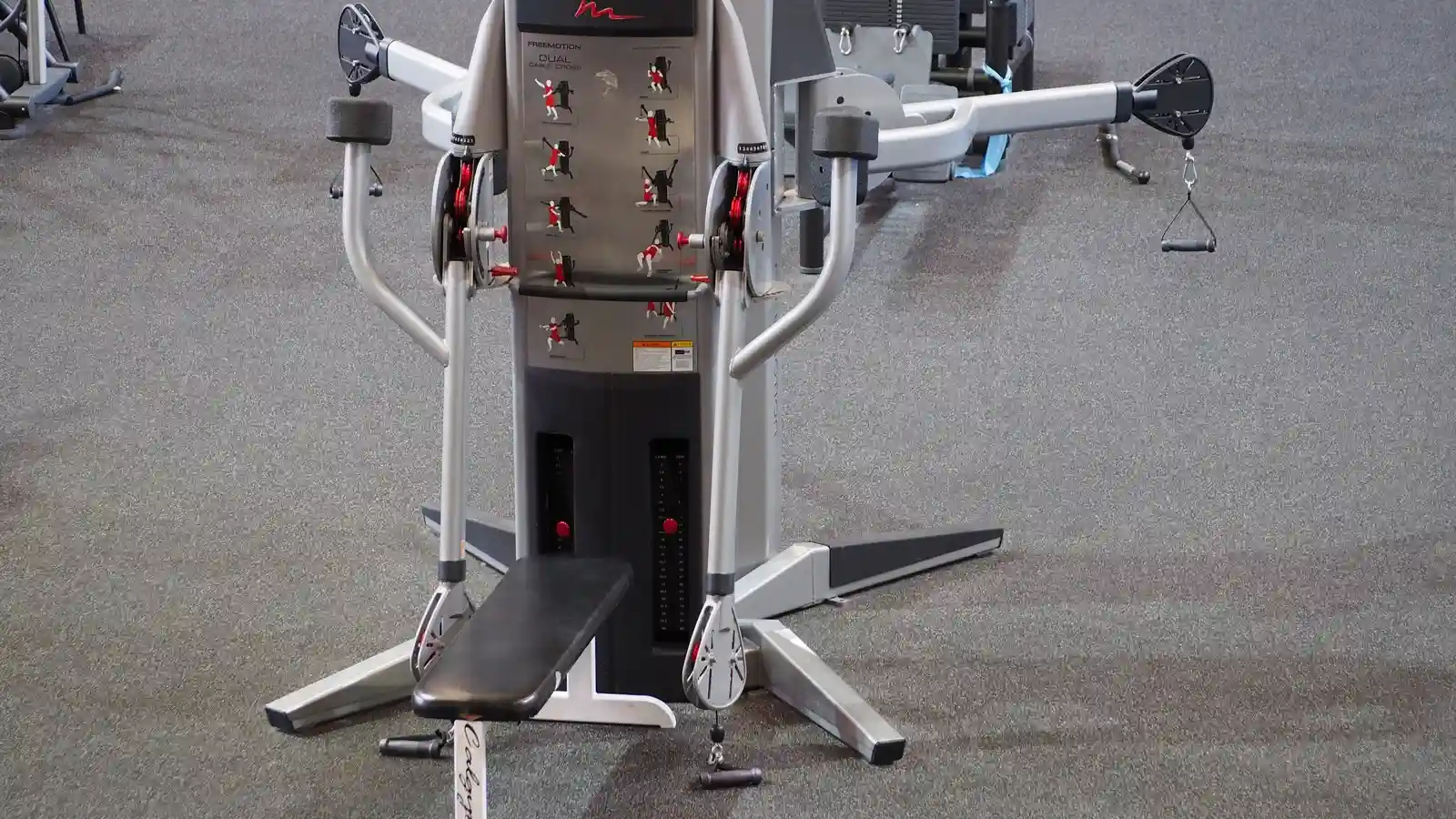
Here is the part most equipment lists get wrong. A dual-stack functional trainer is one frame and two stations. A cable crossover with two columns is one frame and effectively two stations at a time if the pulleys are set at different heights, one if everyone wants the same height. A four-stack multi-jungle is one frame and four stations.
So when you run the math above, the output is simultaneous users, not machine count. A club that needs 10 positions can buy five dual-stack units, or four dual-stack units and two lat pulldowns, or one multi-jungle and six singles. The floor plan decides which combination fits, not the math.
Practical translation for a typical 2,000-member club:
| Station type | Count | Positions | Serves |
|---|---|---|---|
| Cable crossover or dual adjustable pulley | 2 | 4 | Chest fly, rear delt, triceps, curls, core |
| Functional trainer (dual stack, 2:1) | 1-2 | 2-4 | Full-body, rehab, PT sessions, small group |
| Lat pulldown | 2 | 2 | Vertical pull, the most used single cable movement |
| Seated row or low row | 1-2 | 1-2 | Horizontal pull |
| Multi-jungle or 4-stack | 0-1 | 4 | High-traffic clubs short on floor space |
| **Total** | **6-8 frames** | **10-13** |
The 2:1 ratio changes what you are buying
Cable machines are sold on stack weight, and stack weight is a marketing number. What a member feels at the handle depends on the pulley arrangement.
- 1:1 ratio. Handle load equals the stack weight. A 200 lb stack gives 200 lb at the handle. Cable travel equals handle travel. Common on lat pulldowns and traditional crossovers.
- 2:1 ratio. Handle load is about half the stack, cable travel is double. A 200 lb stack gives roughly 100 lb per handle, and the cable moves twice as far as your hand. Standard on functional trainers, because long travel is what makes the exercises work.
Neither is better. They do different jobs. A 2:1 functional trainer with a 200 lb stack cannot load a heavy row, so if heavy pulling is your goal, the lat pulldown next to it needs a 250 lb stack at 1:1. The buying mistake is ordering a 2:1 machine with a 150 lb stack and expecting it to cover strength work. It won’t, and the members who need real load will go to the plate-loaded row instead.
What to specify before the container ships
| Spec | Light commercial | Full commercial | Why |
|---|---|---|---|
| Cable | 4-5 mm, 6×19 or 7×19 galvanised | 5-6 mm, 7×19 galvanised, swaged ends | Breaking strength 1,500-2,500 lb. Thin cable with tight pulley radius is the number one failure |
| Pulley | Nylon wheel, plain bore | Sealed-bearing pulley, 90-115 mm | A flat-spotted pulley makes the stroke lumpy and eats cable |
| Weight stack | 100-150 lb | 200-250 lb, 10 lb plates with a 5 lb adder | Check the ratio before you compare stack numbers |
| Guide rods | 20-25 mm, chrome | 25-30 mm, hard chrome | Pitting in humid gyms is a real problem, plating thickness matters |
| Column height | 76-84 in | 84-92 in | Taller column means a higher high pulley, which changes what you can train |
| Frame | 2×2 in, 14 gauge | 2×3 in or 2×2 in, 11 gauge, full-perimeter weld | Cables pull sideways. A bolted flat-pack frame flexes |
| Adjustment | Pin and hole, 8-12 positions | Pop pin or gas strut, 15-20 positions with numbered detents | Members set the height wrong when they can’t see the numbers |
| Handle hardware | Fixed D-handles | Swivel snap hooks plus a handle set | Without swivels, the cable twists and the coating fails early |
Two factory-side notes. First, ask for the cable length list and the pulley part numbers with the order. A cable is a wear item with an 18 to 36 month life in a busy club, and a machine that needs a custom-length cable air-freighted from China is a machine out of service for three weeks. Second, order a spare cable and pulley kit per machine type with the container. It costs a fraction of an emergency shipment and it is the difference between a two-hour repair and a fortnight of downtime.
Placement rules that decide if the count works
| Dimension | Number | Note |
|---|---|---|
| Working space in front of a cable station | 36-48 in | Less than 36 in and members train at an angle, which loads the frame sideways |
| Between two cable columns (crossover) | 36-48 in of usable space between handles | This is the exercise. Do not squeeze it |
| Distance to the free weight area | Adjacent, not inside | Cables and dumbbells share users, but a cable in the dumbbell aisle is a trip hazard |
| Mirror position | In front of the cable cluster, 12-18 in off the floor | Members watch the movement, and mirrors behind a cable station are useless |
| Ceiling clearance | Column height plus 6 in | A 92 in column under a 96 in soffit is a fit problem discovered on install day |
| Power | None for selectorized cable | One advantage of cables over cardio: no circuits to plan |
The single most common layout mistake is treating the cable cluster as leftover space. It goes at the edge of the strength zone, near the free weights, with the busiest sightline from the front desk. It is also the zone where a trainer can supervise two or three clients at once, which matters if you sell personal training.
What clubs get wrong
- Buying crossovers instead of functional trainers, or the reverse, without deciding. They are different machines. A crossover is for chest, rear delt and isolation work. A functional trainer is for full-body movement and long cable travel. Most clubs need at least one of each rather than three of either. We compared them properly in the functional trainer guide and the cable crossover guide.
- Sizing on stack weight alone. A 250 lb stack at 2:1 is 125 lb at the handle. Ask for the ratio in writing on the quote.
- No spare cables. A club with 10 cable stations and no spares will have two out of service by year two, for want of a $40 part.
- Forgetting the lat pulldown. It is the highest-use single cable movement in almost every club and it is often the first thing cut from a budget list. Bad trade. It is also the cheapest station on the list.
- Open stacks in an unattended gym. In a 24-hour or apartment facility, specify shrouded stacks. Not for looks: open stacks collect dust, and a missing selector pin takes a machine offline.
FAQ
How many cable machines does a 2,000-member gym need? Eight to eleven positions, which usually means six to eight frames once you count dual-stack machines properly. Split roughly two crossover or dual-pulley units, one or two functional trainers, two lat pulldowns, and one or two rows.
Is a functional trainer the same as a cable crossover? No. A functional trainer has two independently adjustable pulleys on a single frame with 2:1 gearing and long cable travel, built for full-body movement. A cable crossover has fixed high and low pulleys on two columns, built for isolation work. They overlap on a few exercises and diverge on most.
How many cable stations does a small studio need? Three to five positions. One dual adjustable pulley unit, one lat pulldown with a low row attachment, and one functional trainer covers nearly every cable exercise a studio client will be asked to do.
How often do cables need replacing? Every 18 to 36 months in a busy club, sooner if the pulleys are worn or the cable rubs at the swage. Inspect monthly at the end fittings, where the strands break first. A cable that shows three broken wires at the swage is finished, regardless of what the rest of it looks like.
Should I buy plate-loaded or selectorized cable machines? Selectorized, for most clubs. The stack is faster to adjust, which matters when members share a station, and it eliminates loose plates on the floor. Plate-loaded cable machines make sense in strength gyms where the load range of a 250 lb stack is not enough.
Getting the cable count right before you order
We build cable stations, functional trainers and lat pulldowns at our factory in Taishan and ship them factory-direct, mixed with cardio and selectorized strength in one container. Send us a floor plan and member count and we will mark up the cable positions before you commit to a purchase order. Start with the cable crossover and functional trainer range, look at the lat pulldown machines if pulling volume is your bottleneck, or contact us with your floor plan.